
Glue marks on EVA footwear may look like a small production issue, but they can directly affect the final appearance of slippers, clogs and sandals.
Many EVA footwear designs use small logos, shoe charms and decorative components. Because these bonding areas are relatively small, even a slight excess of adhesive can extend beyond the edge of the decoration and remain visible on the EVA surface.
For shoe factories, brands and purchasing teams, this creates two practical concerns: maintaining a clean finished appearance and keeping application requirements manageable during mass production.
So, why do glue marks on EVA footwear appear, and what can factories do to reduce them?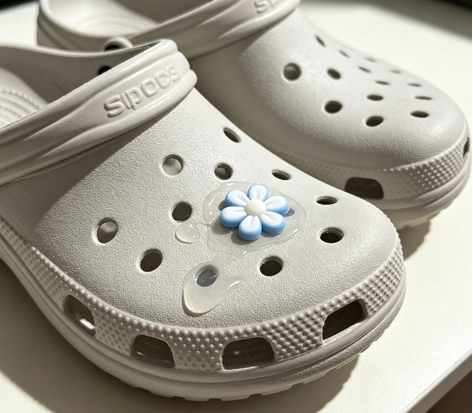
Why Do Glue Marks Appear on EVA Footwear?
Visible glue marks usually come from three separate areas:
adhesive properties, application variation and EVA surface appearance.
Understanding these factors separately makes it easier to identify where the process can be improved.
1. Different Adhesives Create Different Surface Appearances
Using a water-based adhesive does not automatically mean that the coated area will be invisible.
Different water-based adhesive formulations can produce very different results on EVA. After coating, some adhesives may create a noticeable difference in shade, gloss or overall surface appearance.
If the entire coated area is covered by a decorative component, this may not be obvious.
However, once the adhesive extends slightly beyond the bonding edge, the coated area can become visible.
For factories, this means adhesive evaluation should include more than bond strength. The appearance of the EVA surface after application also matters.
2. Small Bonding Areas Allow Less Application Variation
Decorative components on EVA footwear are often small.
A shoe charm, logo or decorative patch may require adhesive on only a limited area. As a result, even a small application deviation can cause the glue to extend beyond the final bonding edge.
This becomes more difficult in mass production, especially when the adhesive is applied manually.
The smaller the bonding area, the less room there is for application variation.
For factories producing large quantities of decorated EVA footwear, this makes application tolerance an important production consideration.
3. EVA Surfaces Can Make Glue Marks More Noticeable
EVA slippers and clogs often have large exposed surfaces with relatively uniform colors and textures.
If a coated area creates a visible change in gloss, shade or texture, the difference can be easy to identify.
This is especially noticeable when a small decorative part is surrounded by a large exposed EVA surface.
For products with higher appearance requirements, the visual effect of the adhesive should therefore be checked before mass production.
How Can Shoe Factories Reduce Glue Marks on EVA Footwear?
Reducing visible glue marks does not depend on one single action.
For production teams, the problem can be improved from three independent areas:
application area, adhesive quantity and adhesive selection.
1. Control the Glue Application Area
The first step is to keep the adhesive area as close as possible to the actual size of the decorative component.
For small logos, shoe charms and decorative parts, factories can adjust brushes, coating tools or application methods to improve accuracy.
Reducing unnecessary adhesive outside the bonding area directly lowers the risk of visible marks.
However, application control has its limits.
In mass production, it is difficult to make every operator and every application exactly the same.
This means process accuracy can reduce the problem, but it cannot completely eliminate normal production variation.
2. Maintain an Appropriate Glue Coat
Glue area and glue quantity are two different process variables.
Even when the adhesive is applied in the correct position, an unnecessarily thick glue coat can make the coated area more noticeable.
Keeping the adhesive layer stable and appropriate helps reduce surface differences while also improving production consistency.
Factories should therefore evaluate both:
where the adhesive is applied and how much adhesive is applied.
3. Evaluate Adhesive Appearance Tolerance
Process control can reduce variation, but it cannot remove it completely.
This is where adhesive selection becomes important.
For EVA footwear with small decorative components, a suitable adhesive should not only provide the required bonding performance.
Factories should also ask:
What happens if the adhesive extends slightly beyond the bonding edge?
If the exposed coated area remains less noticeable, the adhesive gives operators more tolerance under real production conditions.
For shoe factories, brands and purchasing teams, this can be considered another practical selection factor:
Adhesive Appearance Tolerance
This is particularly relevant when reducing glue marks on EVA footwear is an important appearance requirement.
Conventional Water-Based Adhesive vs. WP683
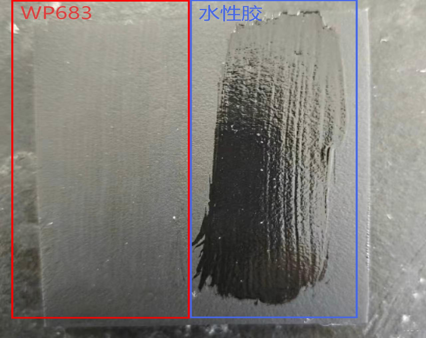
A direct coating comparison on EVA shows why adhesive appearance tolerance matters.
In our test, both products were water-based adhesives, but the visible results after application were clearly different.
With the conventional water-based adhesive, the coated area remained easy to identify. The application area appeared noticeably darker than the surrounding EVA surface, and the coating boundary was clearly visible.
By comparison, WP683 Water-Based Trace-Free Adhesive produced much less visual contrast between the coated and uncoated areas.
The WP683-coated area was far less noticeable.
This comparison highlights an important point:
Not every water-based adhesive is trace-free.
Water-based formulation and trace-free appearance are two separate characteristics.
Why WP683 Fits EVA Decoration Bonding
The comparison above shows why WP683 is relevant to EVA slippers, clogs and other footwear with small decorative components.
Its value can be summarized in two focused characteristics:
Water-Based + Trace-Free
1. Water-Based Adhesive System
WP683 uses a water-based adhesive system designed for decorative bonding applications on EVA footwear.
For factories and brands evaluating water-based bonding technologies, this type of system can support applications such as EVA slippers, clogs, sandals and other products with surface decorations.
Water-based technologies are also relevant to broader solvent-management considerations in footwear production. The European Commission’s EU Ecolabel criteria for footwear cover environmental performance during production, including reduced pollution and the use of hazardous substances.
Learn more about EU Ecolabel requirements for footwear
UK government guidance for adhesive coating and footwear manufacturing also identifies water-borne coatings as one of the techniques used to reduce organic solvent emissions.
Read the UK Government guidance on adhesive coating and footwear manufacturing
For factories looking for more water-based bonding options, HELEY also provides a broader range of Water-Based PU Adhesives for footwear and industrial applications.
Explore HELEY Water-Based PU Adhesives
2. Trace-Free Surface Appearance
The more distinctive characteristic of WP683 is its trace-free appearance on EVA.
In our comparison test, the conventional water-based adhesive left a clearly visible coated area, while the WP683-coated area was much less noticeable.
This difference becomes particularly useful when bonding small logos, shoe charms and decorative components.
If adhesive is applied slightly beyond the intended bonding area, a less visible coating gives operators more room for normal production variation.
For factories, this can reduce dependence on extremely precise glue boundaries while helping maintain a cleaner finished appearance.
This is the key production value of WP683:
not eliminating process control, but increasing application tolerance.
What Should Buyers Evaluate When Selecting Adhesive for EVA Footwear?
For shoe factories, brands and purchasing teams, adhesive evaluation for EVA decoration bonding can be simplified into three practical areas.
1. Bonding Performance
Does the adhesive provide the required bonding performance between the actual EVA and decorative materials?
Bond strength remains the basic requirement.
Factories should test the actual material combination before mass production rather than relying only on general product specifications.
2. Surface Appearance
What does the EVA surface look like after the adhesive is applied?
More importantly:
If the glue extends beyond the bonding edge, does the coated area remain visible?
For EVA slippers and clogs with higher appearance requirements, this should be included in actual material trials.
Testing only bond strength may overlook a surface issue that becomes obvious on the finished product.
3. Production Compatibility
Does the adhesive fit the factory’s existing application method and production conditions?
A good laboratory result is important, but the adhesive also needs to perform consistently under actual factory conditions.
For B2B buyers, a more complete evaluation should therefore consider:
Bonding Performance + Surface Appearance + Production Compatibility
—not bond strength alone.
Reducing Glue Marks on EVA Footwear Requires More Than Precise Application
Visible glue marks on EVA footwear can result from adhesive properties, application variation and EVA surface characteristics.
Factories can reduce the problem by controlling the application area, maintaining an appropriate glue coat and selecting an adhesive with better appearance tolerance.
The comparison between a conventional water-based adhesive and WP683 also shows an important distinction:
Water-based does not automatically mean trace-free.
For EVA slippers, clogs and other decorated footwear where both bonding and appearance matter, WP683 combines a water-based adhesive system with a less visible, trace-free finish on EVA.
The goal is not to eliminate process control.
It is to provide production teams with more application tolerance while helping the finished EVA surface remain cleaner and more consistent.
