
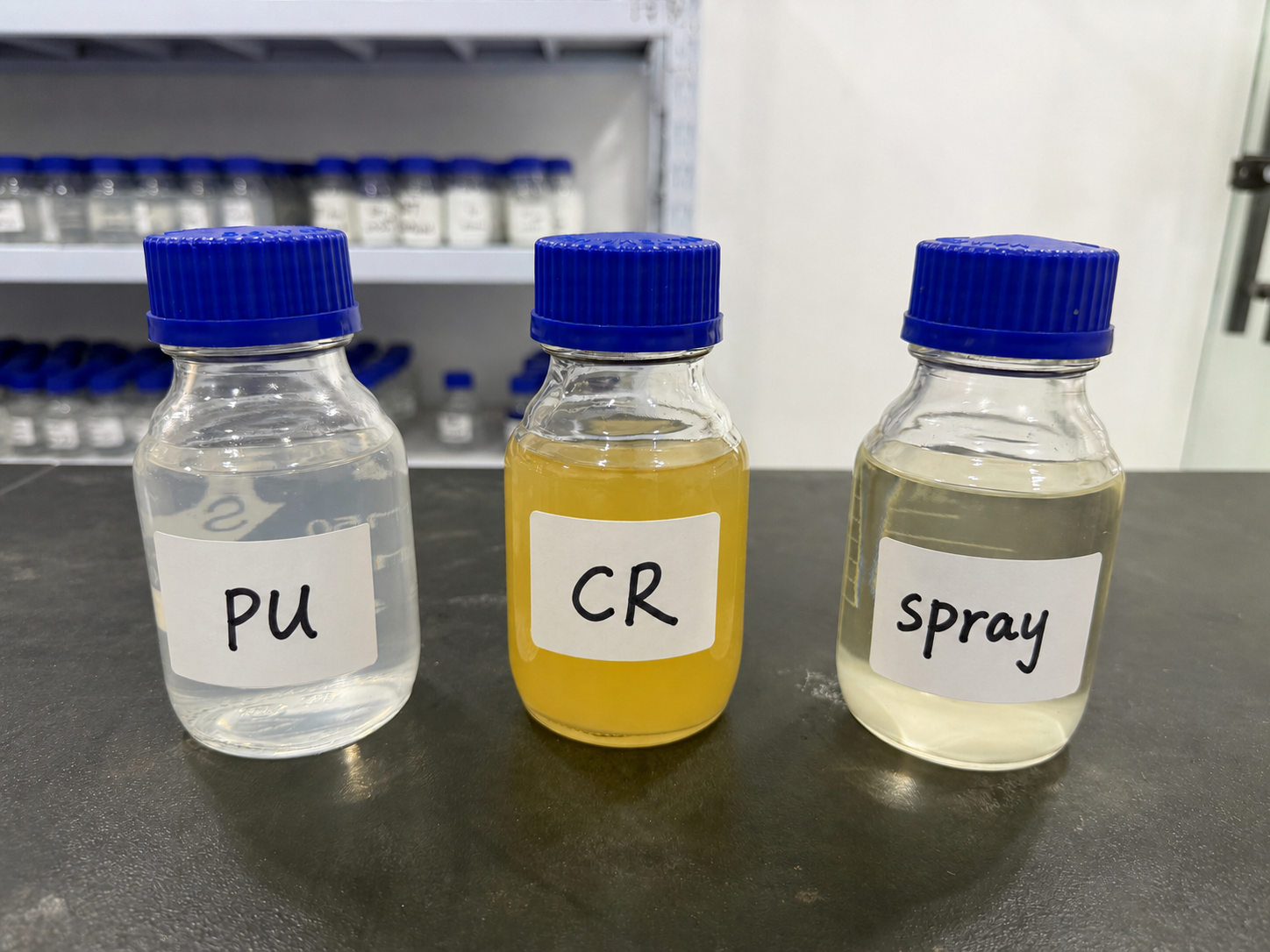
PU adhesive, chloroprene adhesive and spray adhesive are widely used in footwear manufacturing. However, they solve different production problems.
A strong initial bond does not always mean good long-term durability. Applying more adhesive also does not always produce higher bonding strength.
For footwear factories, the right adhesive should be selected according to the material, production process and end-use environment.
Table of Contents
- PU Adhesive for Long-Term Shoe Bonding
- Chloroprene Adhesive for Fast Positioning
- Spray Adhesive for Foam and Fabric Lamination
- PU, Chloroprene and Spray Adhesive Comparison
- What Footwear Buyers Should Compare
- Conclusion
PU Adhesive for Long-Term Shoe Bonding
PU adhesive is mainly used for structural bonding, especially between shoe uppers and outsoles.
Many PU adhesives show high peel strength immediately after pressing. However, footwear may later experience transportation, warehouse storage, high temperature, humidity and repeated flexing.
For this reason, aged bonding strength is often more important than initial strength.
3081 Wet-Heat Ageing Test
Bonded samples using 3081 PU adhesive were tested under:
-
70°C
-
95% relative humidity
-
240 hours
The peel strength was 8.5 kg/cm before ageing and 8.2 kg/cm after ageing.
The strength retention rate reached approximately 96%.
Peel strength is commonly evaluated under controlled test conditions. For reference, ASTM D903 describes a standard method for testing the peel or stripping strength of adhesive bonds.
This indicates that 3081 can maintain stable bonding performance after prolonged exposure to heat and humidity. It is suitable for upper-to-outsole bonding, sports shoes, work shoes and footwear exported to tropical markets.
3081 also uses a toluene-free formulation, making it suitable for factories with higher environmental and production-safety requirements.
Chloroprene Adhesive for Fast Positioning
Chloroprene adhesive, also known as CR adhesive, is commonly used where fast initial tack and anti-rebound performance are required.
It is particularly suitable for materials that may spring open or shift after bonding.
3285 Anti-Rebound Test
Under the same material, bonding area, adhesive amount and open-time conditions, test pieces bonded with 3285 were left for 30 seconds and then loaded with a 1,000-gram weight.
After 60 minutes, the sample moved only approximately 1 centimetre.
This shows that 3285 can provide stable initial positioning in a short time.
Typical applications include:
-
Upper edge wrapping
-
Heel wrapping
-
Insole wrapping
-
Curved material bonding
-
Flexible components
Its cured adhesive film remains soft, making it suitable for areas that require bending and repeated movement.
In simple terms:
PU adhesive helps prevent future delamination.
Chloroprene adhesive helps prevent immediate rebound.
Spray Adhesive for Foam and Fabric Lamination
Spray adhesive is mainly used for large-area bonding, especially foam-to-fabric lamination.
The key is not applying as much adhesive as possible. The important factors are:
-
Spray uniformity
-
Coverage per square metre
-
Drying time
-
Adhesive consumption
-
Peel strength
-
Production efficiency
3198 Spray-Weight Test
3198 spray adhesive was tested at three application weights:
-
50 g/m²
-
100 g/m²
-
200 g/m²
When the spray weight increased from 50 g/m² to 100 g/m², coverage and peel strength improved significantly.
However, increasing the amount to 200 g/m² did not create a clear increase in bonding strength. Instead, it resulted in:
-
A thicker adhesive layer
-
Longer drying time
-
Higher adhesive consumption
-
Increased production cost
The test shows that a reasonable spray weight can provide better cost and performance balance than excessive application.
3198 is suitable for:
-
Foam-to-fabric lamination
-
Shoe upper material lamination
-
Cushioning materials
-
Large-area lightweight material bonding
PU, Chloroprene and Spray Adhesive Comparison
| Adhesive | Main function | Typical application |
|---|---|---|
| PU adhesive | Long-term durability | Upper-to-outsole bonding |
| Chloroprene adhesive | Fast positioning and anti-rebound | Wrapping and curved components |
| Spray adhesive | Uniform large-area coverage | Foam and fabric lamination |
PU adhesive acts as the structure, chloroprene adhesive provides flexible positioning, and spray adhesive provides efficient coverage.
What Footwear Buyers Should Compare
When selecting a footwear adhesive, procurement teams and engineers should compare more than the price per kilogram.
Important factors include:
-
Peel strength after ageing
-
Strength retention rate
-
Initial tack
-
Anti-rebound performance
-
Adhesive-film flexibility
-
Open time
-
Application weight
-
Cost per square metre or per pair
-
Batch consistency
The adhesive should also be tested with the factory’s actual materials, primers, hardeners and production conditions.
Conclusion
There is no single best adhesive for every part of a shoe.
3081 PU adhesive is designed for long-term bonding and hydrolysis resistance.
3285 chloroprene adhesive is designed for fast positioning, anti-rebound performance and flexibility.
3198 spray adhesive is designed for uniform coverage and efficient foam-to-fabric lamination.
The correct footwear adhesive is not simply the strongest or fastest product. It is the adhesive used in the right material combination, production process and operating environment.