
A reliable adhesive bonding system is important for multi-material footwear. The right result depends on material matching, joint design, surface treatment, and production control.
Modern sports shoes, casual shoes, and work shoes often use many materials in one product.
These may include EVA, rubber, TPU, PU, fabric, and synthetic leather.
Using many materials can improve shoe design and performance. But it can also make bonding more difficult.
Many bonding problems are not caused by “weak glue” alone. The real cause may be the material mix, joint design, use conditions, or production process.
A reliable bonding system should be built from two sides:
First, design the multi-material shoe structure well. Second, build the right adhesive system for each bonding area.
1. How Should Multi-Material Footwear Be Designed?
1.1 Define the Material Combination First
The first step is to know which materials need to be bonded together.
For example:
- Upper to midsole
- EVA midsole to rubber outsole
- TPU part to EVA
- Decorative part to synthetic leather
- Fabric to foam material
For a shoe factory, a simple material list is not enough.
It is better to make a bonding interface list.
For each bonding area, check:
- What are the two materials?
- What is the surface condition?
- Is there oil, release agent, or other dirt?
- Is the surface smooth, porous, or foamed?
- Can the material change from batch to batch?
For example, two materials may both be called EVA. But their formula, density, and surface can be different.
This means a change of material supplier may also change bonding results.
So, when a shoe factory changes a material supplier, the bonding system may need to be tested again.
1.2 Design the Joint to Reduce Peel Risk
Bond strength is not only about the adhesive.
The shape of the shoe part also matters.
Areas such as the toe, forefoot edge, and sidewall often have higher peel stress than flat areas.
During shoe design, focus on three points.
Use enough bonding area.
A very small bonding area can create higher stress.
Reduce stress at the edge.
Sharp corners and high-flex areas can become the first place where bonding fails.
Make sure the two parts fit well.
If there is a large gap between two parts, adding more adhesive may not solve the problem.
When the same area keeps opening, do not only ask for a stronger adhesive.
The shoe structure should also be checked.
1.3 Set Bonding Needs Based on Real Use
Different parts of a shoe face different stress.
For example:
The forefoot bends many times.
The toe area has high peel stress.
The heel gets more shock and shear force.
The outsole may face water, dirt, heat, and cold.
So, one peel strength value is not enough for every bonding area.
Footwear bond performance can also be checked with industry test methods. For example, SATRA TM411 measures the peel strength between the sole and upper, as well as bonded layers in the bottom construction.
For sports shoes, outdoor shoes, or shoes sold in hot and wet markets, other points may also matter.
These include:
- Heat resistance
- Water resistance
- Hydrolysis resistance
- Flex resistance
- Bond strength after aging
The first question should be:
What will this bonding area face during real use?
After that, the factory can choose the right adhesive system.
2. How Should the Adhesive Bonding System Be Designed?
2.1 Surface Treatment Comes Before Adhesive Selection
Many bonding problems start before the adhesive is applied.
Dust, oil, release agent, or a low-energy surface can stop the adhesive from bonding well.
Different materials may need different surface treatment. For a deeper look at how primers improve bonding on EVA, rubber, TPU, and other shoe materials, read our guide on improving bond strength with surface primers.
This may include:
- Cleaning
- Grinding
- Priming
- Surface activation
- Other pre-treatment methods
One key rule is simple:
A high-performance adhesive cannot replace correct surface treatment.
Buyers should not compare adhesives only by strength data.
They should also check the surface treatment needed for each product.
If one adhesive needs many extra steps, this can add labor, time, and production cost.
These costs should also be part of the buying decision.
2.2 Match the Adhesive System to Each Bonding Area
In multi-material footwear, one adhesive may not work well for every part.
A better method is to build a full system for each key bonding area.
This may include:
Primer + main adhesive + hardener or activation process
The factory can then choose a suitable adhesive type based on the material and process.
Common options may include:
- Water-based PU adhesive
- Solvent-based PU adhesive
- PUR reactive hot melt
- Other special systems for certain materials
Do not only look at initial bond strength.
Also check:
- Heat resistance
- Hydrolysis resistance
- Flexibility
- Open time
- Activation needs
- Cure speed
- Long-term aging performance
For buyers, the key question is not:
“Which adhesive is the strongest?”
A better question is:
“Which bonding system fits our materials, production line, and end-use needs?”
2.3 Build a Stable Production Window
A bonding system may work well in the lab but fail in mass production.
A normal footwear bonding process may include:
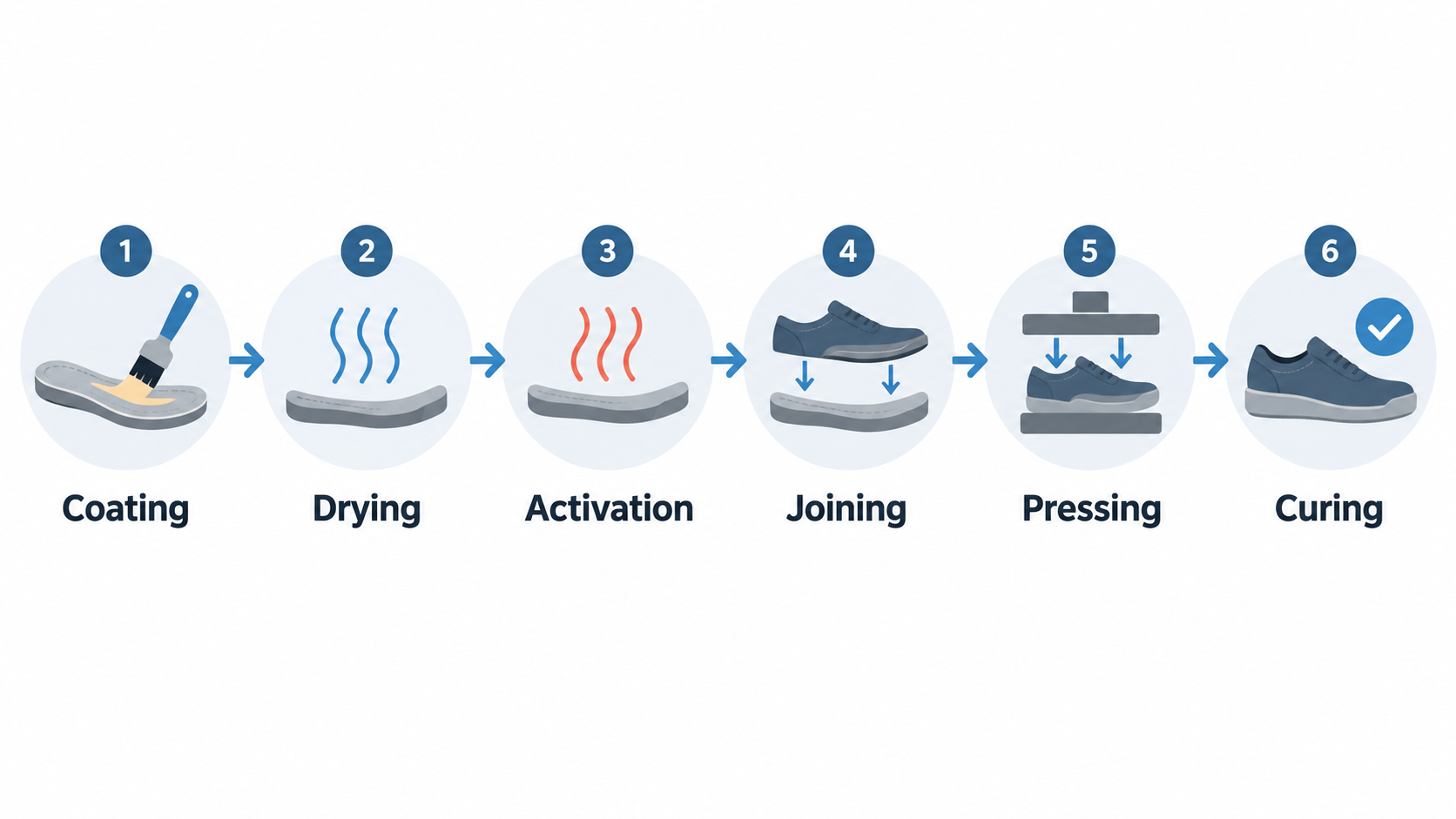
Each step can affect the final result.
For example:
Too much adhesive does not always give a stronger bond.
A long open time may reduce bonding performance.
The wrong activation temperature may lower bond strength.
Low pressure or short pressing time may cause weak local bonding.
So, a factory should not depend on one “perfect number.”
It should build a stable production window.
This means setting a safe range for each key process step.
A clear production window can reduce operator error and improve results across different lines and shifts.
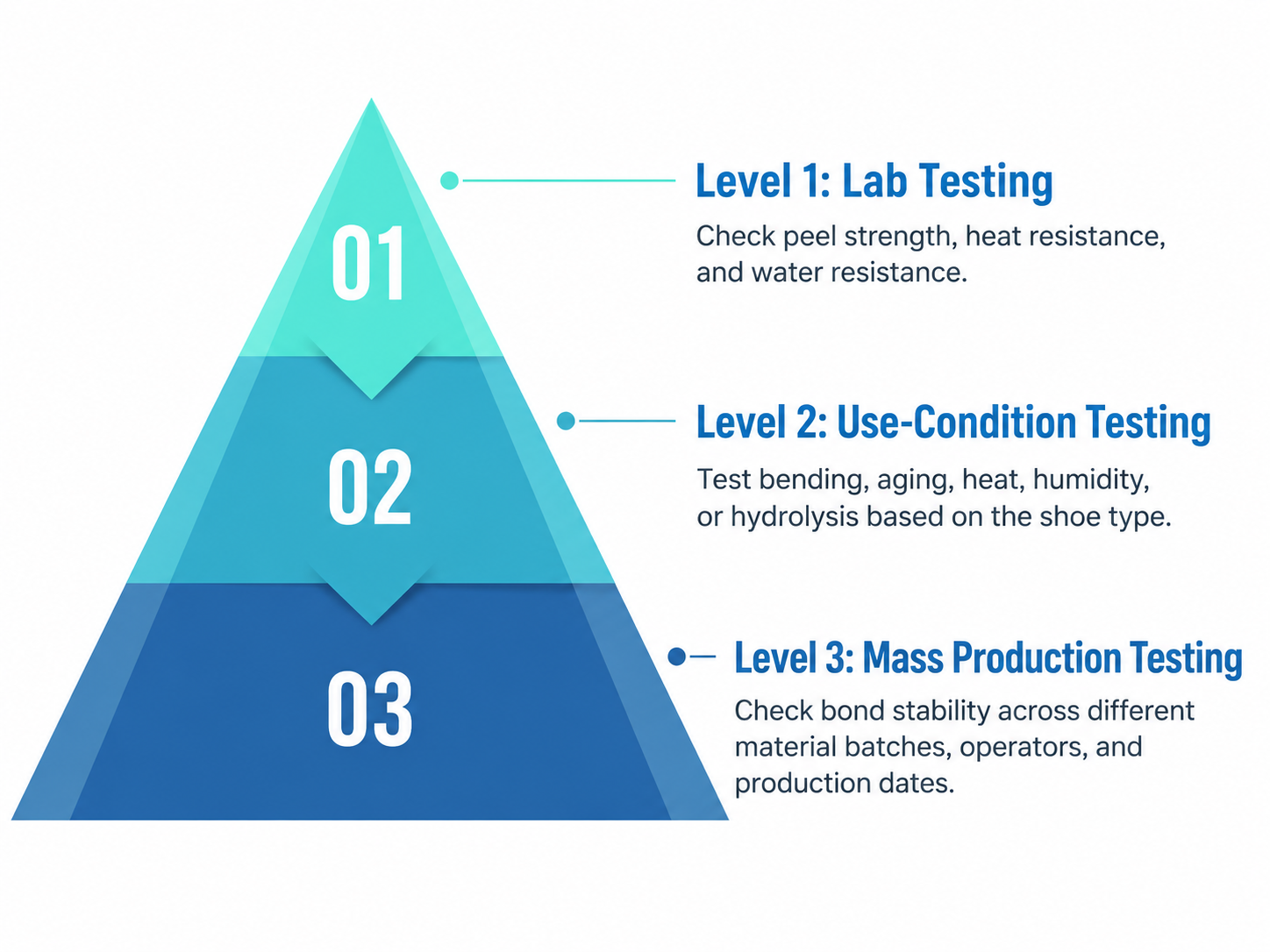
2.4 Check Both Lab Results and Mass Production Results
A reliable bonding system must be tested before full production.
Testing can be divided into three levels.
Brand owners and buyers should also check the adhesive supplier.
Important points include:
- Batch consistency
- Technical support
- Change control
- Problem analysis
- Fast response when bonding issues happen
A reliable system is not one that works well only once.
It should give stable results under the set material, process, and use conditions.
Conclusion: Move from “Choosing Glue” to “Building a Bonding System”
Multi-material footwear needs more than a strong adhesive.
A good bonding system should consider:
Material combination, joint design, use conditions, surface treatment, adhesive selection, production process, and long-term testing.
For shoe factories and brand owners, this system approach can reduce repeated adhesive trials.
It can also help lower the risk of delamination, rework, and unstable production.
If you are working with EVA, rubber, TPU, PU, fabric, synthetic leather, or other footwear materials,HELEY can help you review the bonding needs of each interface.
Heli can support customers with adhesive selection, surface treatment, process matching, and mass production needs.
Our goal is not only to offer an adhesive.
We aim to help customers build a more stable bonding system for real footwear production.
For multi-material footwear, the right bonding system matters more than simply choosing a “stronger glue.”
